

Choosing a tattoo removal laser is not simply about selecting the highest energy or newest platform. Clinics must match wavelength, pulse characteristics, spot size, cooling, and beam quality to the pigment and the patient’s skin type. Different colors absorb light differently, while epidermal melanin competes with tattoo pigment for energy. A sound buying decision begins with the clinic’s case mix, not a generic “best machine” claim.
Why Does Tattoo Removal Laser Wavelength Matter?
How Tattoo Ink Absorbs Laser Energy
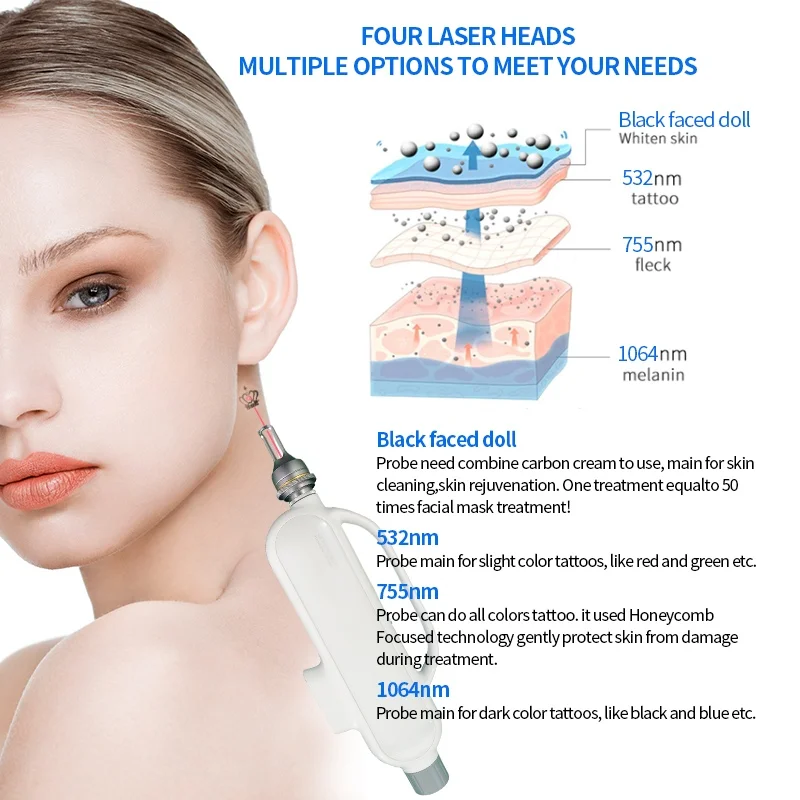
Laser tattoo removal uses the process of selective absorption. By choosing a wavelength that is specifically absorbed by the target colors in the tattoo, the laser creates a quick photoacoustic and thermal effect in the pigments. This breaks down the larger pigment particles into much smaller fragments of ink. Over time, these small pieces of ink are removed from the body.
The way you experience the color of your tattoos depends on more than just the color you can see. How the ink was made, the depth and density of where the ink was placed, previous treatments to the skin, and the amount of melanin in your epidermis can all affect how much of the ink is absorbed by your skin. So, for example, a very dense professional tattoo of black ink will likely be perceived very differently than a very light cosmetic tattoo of red ink.
Why One Wavelength Cannot Treat Every Tattoo Color Equally
A single wavelength does not equally interact with all pigments. Dark inks generally interact with longer Nd:YAG wavelengths, while red and other warm-toned inks interact best with shorter wavelengths. Green, turquoise, and some blues are more resistant and may require another wavelength or a multi-session approach planned with due care.
Clinics should evaluate coverage by wavelength rather than machine category alone. A system described as Q-Switched or picosecond is not automatically suitable for every color. Available wavelengths, actual output, beam profile, and operator control determine its practical versatility.
Which Tattoo Removal Laser Wavelength Matches Each Ink Color?
How Does a 1064nm Tattoo Removal Laser Treat Black and Dark Ink?
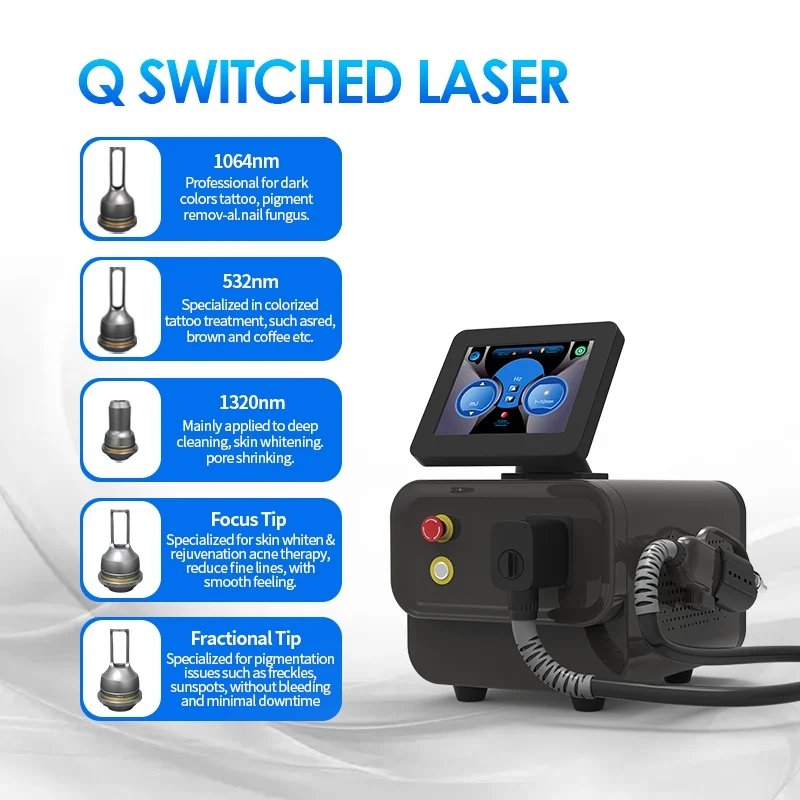
The 1064nm Nd:YAG wavelength is often used for removing black, dark blue, and other deep-colored tattoos. Due to its depth of penetration, it is less absorbed by the epidermal melanin than the shorter wavelengths and is often effective for removing difficult dark tattoos as well as for individuals of higher Fitzpatrick skin type.
To treat a very dark black tattoo, the operator starts with a conservative amount of fluence and a spot size most appropriate to the area of skin being treated. Adjustments to be made in subsequent sessions for whitening, fading, and skin healing. Do not rush treatment by increasing energy levels. Consistent and even output is paramount to avoiding any unwanted skin reactions that an errant hot spot could cause.
How Does a 532nm Tattoo Removal Laser Treat Red and Warm-Toned Ink?
532nm is a very common wavelength for the red, brown, and orange colors and some of the cosmetic tattoos. Its shorter wavelength is very complementary to the 1064nm for treating the darker as well as the warmer-toned inks in the clinic.
The wavelength of 532nm is absorbed strongly by epidermal melanin and so requires consideration of the patient’s skin type before treatment. Treatment should be conducted with conservative settings, the use of test spots, the use of cooling, and with adequate time between treatments. Darker skin types or recently tanned individuals require particular consideration.
When Are 755nm or Other Wavelengths Considered for Green and Blue Ink?
Some green and blue pigments are not amenable to standard 1064nm and 532nm removals. A 755nm option could be considered for resistant colors on a case-by-case basis, but it depends on pigment and device output. Tip alone is not enough for removal.
|
Tattoo characteristic |
Commonly considered wavelength |
Main purchasing concern |
|
Black or dark blue ink |
1064nm |
Stable energy at practical spot sizes |
|
Red, brown, or orange ink |
532nm |
Epidermal melanin absorption |
|
Green or turquoise ink |
755nm or another suitable option |
Verified wavelength and beam consistency |
|
Multicolor tattoo |
Multi-wavelength platform |
Switching, calibration, and training |
How Should Clinics Match Tattoo Removal Lasers to Skin Type?
Why Does Fitzpatrick Skin Type Change Laser Selection?
The Fitzpatrick classification is used by operators to estimate the patient’s skin type and its potential reaction to certain light sources. Because of the high amount of epidermal melanin in darker skin types, operators must use more conservative parameters and pay close attention to the desired endpoint as well as the skin’s overall recovery.
1064nm may be preferred for dark ink on higher skin types, but no wavelength can replace test spots, patient screening, assessment of sun exposure to the tattoo, and appropriate, qualified use of the laser. Recent tanning, irritation, a history of abnormal scarring, and previous change of pigment are all relevant.
How Do Fluence, Spot Size, Pulse Width, and Cooling Affect Safety?
Four specifications should be reviewed together:
1. Fluence shows the energy that goes to each part of the treatment area. Fluence tells you how much energy each spot receives.
2. Spot size affects penetration, coverage, and energy density.
3. Pulse width influences how quickly energy reaches pigment.
4. Cooling supports epidermal protection and stable operation.
The beam distribution or beam uniformity is also important to be top-hat-like in order to avoid high peaks. Also accurate aiming, constant output, and sufficient adjustment range for small cosmetic tattoos and very large tattoos on the body.
Q-Switched vs Picosecond Tattoo Removal Lasers
How Does Pulse Duration Change Ink Fragmentation?
Typically, Q-switched lasers are able to deliver pulses in the nanosecond range, whereas so-called picosecond lasers are able to deliver even shorter pulses. However, the photoacoustic effect will not increase automatically with shorter pulse duration. A variety of further parameters have to be taken into account, such as wavelength, pulse energy, spot size, beam profile, as well as tattoo density and treatment technique.
Instead of an old vs new comparison, we are looking to see if the new platform delivers consistent amounts of energy at practical fluences for all relevant colors and patient skin types and types treated at your typical clinic.
Which Tattoo Removal Laser Platform Fits Common Clinic Cases?
Consider three clinic scenarios:
1. Black body tattoos require reliable 1064nm treatment, variable spot size, cooling, and high repetition rate.
2. A center treating red cosmetic tattoos and dark body art would benefit by offering a 1064nm and 532nm treatment option.
3. For high-volume clinics treating a variety of pigment-based skin concerns, additional tips, wider treatment parameters, and stronger thermal control will be of use.
At KES laser we have several models designed for various needs. The MED-860 Reno is a multi-functional laser. It has 1064nm and 532nm in one system. The frequency is 1-10Hz. The beam size is 2-10mm which is adjustable. It comes with a water cooling system and top-hat beam design.
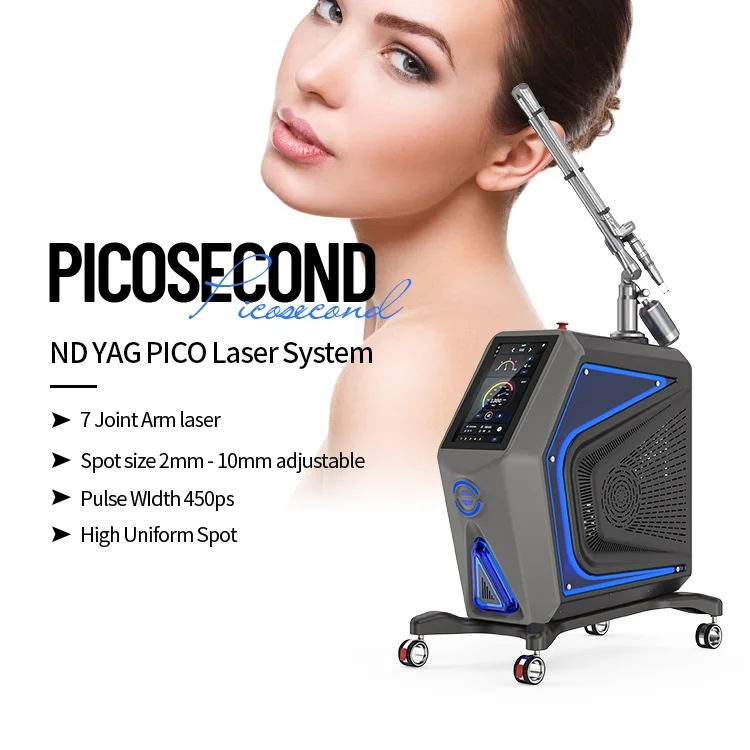
The MED-810A Tiny has five different tips. 1064nm, 532nm, 1320nm, 755nm focus tip and 1064nm fractional tip. It has a 3ns pulse width. Frequency is adjustable from 1-10Hz. The spot size is 1- 8 mm. The system also comes with double rods and three types of cooling systems: air cooling, water cooling, and twin-radiator cooling.
What Should Clinics Check Before Buying a Multi-Wavelength Tattoo Removal Laser?
Which Technical Specifications Matter Most?
A procurement team should verify:
1. Which wavelengths are standard and which need optional tips?
2. Pulse width and output consistency over frequency.
3. Usable energy at each wavelength.
4. Spot-size range and beam uniformity.
5. Cooling design and continuous-operation capability.
6. Aiming system, interface languages, maintenance access, and calibration support.
7. Certificates required in the destination market.
The initial specification sheet is just the start. Look for opportunities to test-run the software for output, arrange for training, check the warranty, and get a clear idea of how spare parts will be dealt with.
Why Do Training, Calibration, and Manufacturer Support Matter?
A well-specified platform is not enough for optimal results. Clinics need training on aspects such as skin assessment, choosing the correct wavelength, as well as parameter setting to achieve the desired endpoint. Aftercare and maintenance of results also need to be addressed. Calibration is also critical, as over time, output can drift, causing inconsistent results.
KES laser fully supports OEM and ODM projects such as industrial design, mechanical design, software design, interface design, and logo design. In addition, KES laser provides information on our manufacturing process, such as ISO 13485-oriented quality control, energy output and stability test data, multi-language support, etc. Furthermore, we have an after-sales engineering team that can support distributors and also large numbers of clinic sites in configuring equipment for individual users and providing ongoing technical support.
FAQ
Q: What is the best tattoo removal laser wavelength for black ink?
A: A 1064nm Nd:YAG wavelength is typically used for treating black pigment as well as darker colored ink. A protocol should still take into account the depth of ink, the density of the ink, the skin type of the patient, the spot size used, and follow up for each subsequent treatment to assess for any additional change.
Q: Can a 532nm tattoo removal laser remove red and orange ink?
A: Yes. 532nm is typically used to image red, brown, orange pigments, and other warm pigments. Care must be taken with settings to account for strong interaction with epidermal melanin.
Q: Which tattoo removal laser is more suitable for darker skin types?
A: For the removal of dark ink from darker skin, a 1064nm Nd:YAG platform is often preferred as it has lower absorption of epidermal melanin than shorter wavelengths. As with all darker pigment removal, test spots, conservative settings, and proper trained operation are mandatory.
Q: Can one multi-wavelength tattoo removal laser treat every tattoo color?
A: Broadening of treatment options for the removal of different colors of pigment. However, each pigment will not be removed by laser to the exact same degree. Factors which influence the degree of removal include: characteristics of ink used; depth of ink in dermis; age of tattoo; patient’s skin type and prior history of treatments.
Q: Is a picosecond tattoo removal laser better than a Q-Switched Nd:YAG laser for clinics?
A: There is no single “best” solution, and both platforms have their advantages and disadvantages. The only way a clinic can make an educated decision is to compare the following items between platforms: wavelength, pulse output, beam homogeneity, spot-size range, cooling, service & support, and typical case mix that each platform can handle. Don’t be misled by the technology name.