

Choosing the right laser hair removal machine for your clinic is more than comparing the machines’ power. When choosing a laser, you need to consider the types of clients you have, the number of treatments you do, the experience of the people operating the machine, the type of cooling, how the machine will fit into your workflow, and what after-sales service the company provides.
What Is a Professional Laser Hair Removal Machine and How Does It Work?
Professional equipment delivers controlled light energy to melanin associated with the follicle. Absorbed light becomes heat, helping reduce future growth while suitable settings and cooling protect surrounding skin. Professional systems also provide broader parameter control, stronger cooling, and operator-focused software.
How Does Selective Photothermolysis Target Hair Follicles?
Selective photothermolysis depends on four connected variables:
1. Wavelength affects melanin absorption and penetration depth.
2. Fluence determines the energy delivered per area.
3. Pulse width controls how quickly heat is applied.
4. Cooling limits excessive surface heating.
You should provide information on the patient’s skin type, hair color and thickness, the body area to be treated, and the effect of treatment. Simply raising energy does not automatically result in a better outcome.
Is an IPL Laser Hair Removal Machine Actually a Laser?
Although users often search for an IPL laser hair removal machine, IPL is not a true laser. A laser produces a defined wavelength, while IPL delivers filtered broad-spectrum pulsed light. Both can support hair reduction, but their output and treatment range differ.
IPL may suit clinics that also provide photorejuvenation, pigmentation correction, vascular applications, or acne treatments. Diode, Alexandrite, and Nd: YAG platforms offer a more specialized route for hair-removal-focused practices.
Which Hair Removal Technology Fits Your Clinic’s Client Base?
Begin with the clinic’s expected skin tones, hair characteristics, treatment areas, appointment frequency, and demand for additional services.
When Is a Diode Laser Hair Removal Machine the Practical Choice?
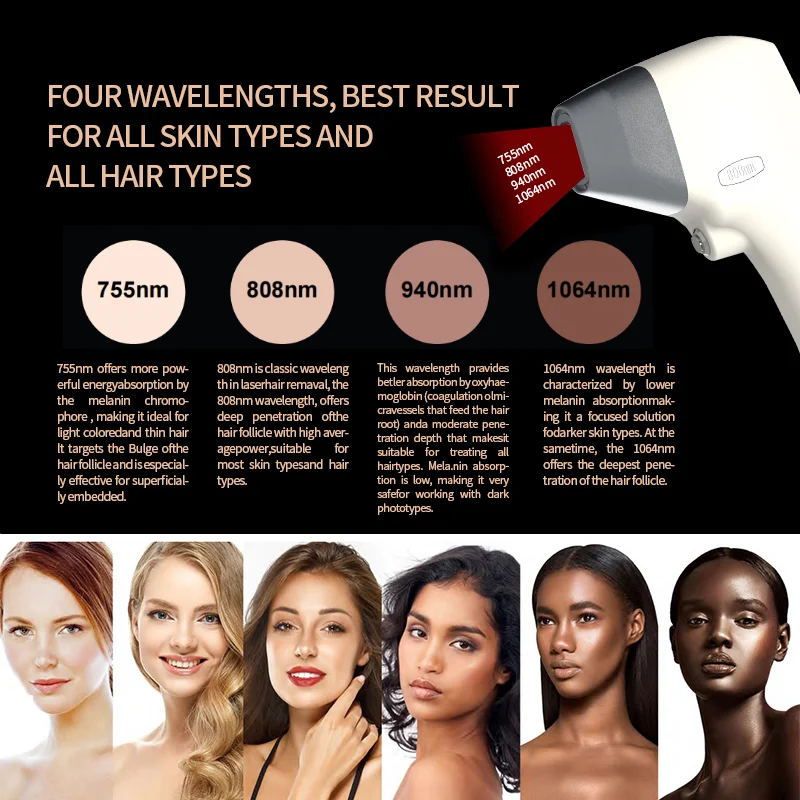
A diode hair removal machine is cost–effective when hair removal is your main treatment. The 808nm is the most widely used wavelength for hair removal. Adding 755nm, 808nm and 1064nm provides your clients with a variety of other treatments. You will compare the performance of pulse adjustment, window size, contact cooling, etc. during a number of repeated full-leg or back treatments.
When Should Clinics Consider Alexandrite and Nd:YAG Wavelengths?
A 755 nm Alexandrite wavelength has strong melanin absorption and is commonly considered for lighter skin with pigmented hair. A 1064 nm Nd: YAG wavelength penetrates more deeply and has lower absorption in epidermal melanin, supporting treatment across a broader range of skin profiles when used with suitable protocols.
A system that provides a combination of treatment with 755nm and 1064nm allows for more flexibility than using two separate platforms in a clinic.
When Does an IPL Hair Removal and Skin Rejuvenation Machine Make More Sense?
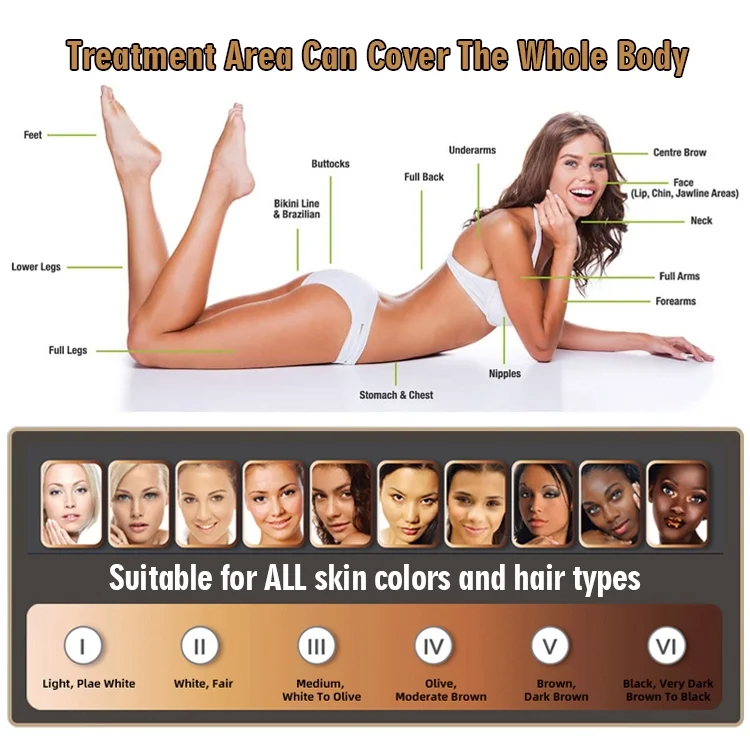
An IPL hair removal and skin rejuvenation machine is useful when a business wants hair reduction and several skin services from one platform. Filter and handpiece options may support photorejuvenation, pigmentation correction, vascular care, and acne treatments.
|
Clinic priority |
Suitable direction |
Main reason |
|
Hair removal as the main service |
Diode or long-pulse laser |
Specialized treatment workflow |
|
Wider skin-profile coverage |
Multi-wavelength or 755/1064 nm |
Greater wavelength flexibility |
|
Hair removal plus skin services |
IPL, SHR, or E-Light |
Broader treatment menu |
|
High appointment volume |
Strong cooling and larger spots |
Faster, steadier workflow |
Which Laser Hair Removal Machine Specifications Matter Most?
Specifications work as one system. High power has limited value if cooling, pulse control, output stability, or ergonomics are weak.
How Do Wavelength, Fluence, Pulse Width, and Spot Size Affect Treatment?
Wavelength affects the intended target and penetration depth. Fluence and pulse width determine how heat is delivered, while spot size influences coverage and treatment speed. Larger spots can improve efficiency on legs and backs, whereas smaller adjustable spots are useful for the face and contoured areas.
Why Are Cooling, Repetition Rate, and Handpiece Design Equally Important?
For subsequent treatments, the same parameters of epidermal protection, comfort, and performance also apply to cooling. Repetition rate affects treatment speed but only provides value if treatment parameters such as energy and cooling are held constant. Weight of handpiece and cable action, treatment window size, and facility for cleaning also affect the amount of fatigue suffered by the operator and therefore their efficiency on a daily basis.
A practical assessment should include a full-area demonstration, repeated cycles, interface testing, and maintenance review.
How Should Clinics Evaluate Safety, Workflow, and Long-Term Ownership?
The decision should reflect daily operations. Training, maintenance access, and technical response can be as important as wavelength selection.
Can the Machine Support Your Clients, Operators, and Daily Schedule?
Check whether the system supports structured skin and hair assessment, preset and manual modes, clear treatment records, and maintenance alerts. The interface should help new operators follow protocols while allowing trained practitioners to adjust parameters.
Clinic scenario: A practice performing six appointments daily plans to add full-leg treatments. Instead of selecting by power alone, it compares spot size, cooling during long sessions, protocol storage, handpiece comfort, and service access.
What Should You Verify About Training, Warranty, Certification, and Support?
Before ordering, verify:
1. Operator training and protocol guidance
2. Warranty coverage and exclusions
3. Spare-part and consumable availability
4. Remote diagnosis and repair procedures
5. Maintenance schedules
6. Certification for the exact model and target market
7. Installation, calibration, and software support
Request documents that match the exact machine configuration and target market.
How Can You Match a KES Laser Hair Removal Machine to Your Clinic?
KES laser develops light-based medical and aesthetic systems and supports OEM and ODM design. Our diode, long-pulse, IPL, E-Light, and SHR options serve different clinic models.
Which Machine Fits a Hair-Removal-Focused Clinic?
The KES laser MED-808 offers 808 nm as standard, with an optional 755 nm, 808 nm, and 1064 nm tri-wavelength configuration. It provides a pulse-width range of 10 to 400 ms, an energy density of 10 to 125 J/cm², and a 12 × 12 mm spot size. The standard power is 500 W, with 1200 W optional.
For clinics seeking long-pulse technology, the KES laser MED-900 combines 755 nm and 1064 nm wavelengths. It offers pulse widths from 0.3 to 100 ms and adjustable standard spot sizes from 6 to 14 mm. Optional 20, 22, and 24 mm spots support coverage of larger areas. Compressor and water cooling help manage heat during operation.
The choice between the two systems depends on the clinic’s client base and treatment strategy. The MED-808 offers the flexibility of an optional tri-wavelength configuration, while the MED-900 provides a combined Alexandrite and Nd:YAG approach with several adjustable spot-size options.
Which Machine Fits a Multifunction Aesthetic Business?
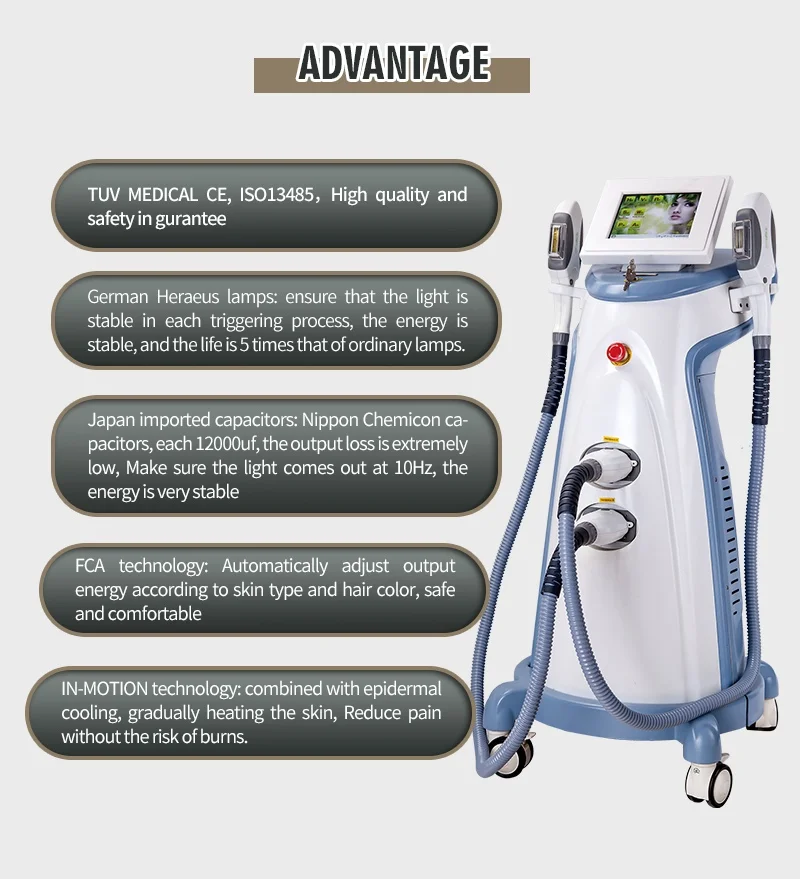
The KES laser MED-230 combines SHR at 650 to 950 nm with E-Light filters at 430, 530, and 640 to 1200 nm. Its SHR handpiece is 15 × 50 mm², its E-Light handpiece is 15 × 35 mm², and the SHR repetition rate ranges from 1 to 10 Hz.
Gradual heating, in-motion delivery, and contact cooling support workflow efficiency. Preset modes recommend parameters from skin and hair characteristics, while professional modes allow manual adjustment.
This configuration is suited to an aesthetic business that does not want to limit its treatment menu to hair removal. In addition to SHR hair reduction, the system can support photorejuvenation, pigmentation correction, vascular applications, acne treatments, and wrinkle-related procedures through its different technology options.
KES laser also provides training materials, online support, multilingual communication, and OEM or ODM services. These services can be valuable for distributors, clinic groups, and businesses that need customized software, interfaces, functions, or branding.
FAQ
Q: Is an IPL laser hair removal machine the same as a diode laser hair removal machine?
A: No, IPL uses filtered broad-spectrum light, whereas a diode laser uses a specific wavelength or a combination of specific wavelengths to treat certain conditions and areas of the body. The method in which the energy is delivered, and the parameters chosen to apply that energy, are also quite different from IPL. Therefore, IPL and a diode laser have very different uses.
Q: Which wavelength should a professional laser hair removal machine have?
A: Typical wavelengths are 755nm, approximately 808nm and 1064nm. Various lasers can be more suitable for clients with different skin types, hair color, hair thickness, hair root depth, and treatment regimens.
Q: Can an IPL hair removal and skin rejuvenation machine replace a dedicated laser?
A: Is suitable for a clinic that requires hair reduction as well as some skin treatments. Dedicated diode, Alexandrite, or Nd: YAG systems are more suitable when hair removal is the main treatment of a clinic.
Q: What should I check before buying a laser hair removal machine for my clinic?
A: Check for the following: wavelength options, usable energy, pulse options, spot size, cooling, handpiece design, operator training, warranty, maintenance, spare parts, technical support, as well as model-specific regulatory compliance documents. A realistic treatment demo is also very important.