

Choosing the best laser for tattoo removal in 2026 requires careful alignment of pulse duration with wavelengths. Energy delivery forms another key part. Cooling needs proper setup along with service support. Operating cost must fit the clinic’s patient mix and business plan.
Which Tattoo Removal Laser Is Best for Your Clinic?
A picosecond platform suits a clinic focused on premium services for complex, resistant, or multicolored cases. A Q-switched Nd:YAG system gives clinics a practical option when they seek proven technology with solid wavelength coverage and manageable purchase costs.
|
Decision factor |
Picosecond system |
Q-switched Nd:YAG system |
|
Pulse range |
Picosecond |
Nanosecond |
|
Typical position |
Premium or advanced service |
General tattoo and pigment service |
|
Capital planning |
Usually higher |
Often easier for a new clinic |
|
Buying priority |
Verify pulse width and wavelengths |
Verify energy, rods, cooling, and service |
Choose a Picosecond Laser When Your Clinic Needs Advanced Multicolor Capabilities
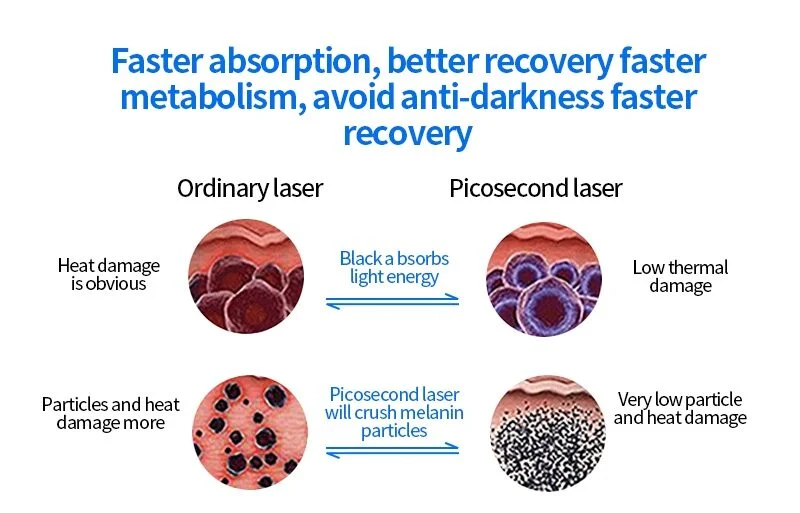
Picosecond laser technology sends energy in shorter pulses than conventional Q-switched platforms. The value comes from a strong photoacoustic effect with limited heat spread. This effect can help with resistant pigment. Multicolor capability still depends on wavelength coverage, so buyers should request verified pulse width, energy, spot-size range, and repetition rate.
Choose a Q-Switched Nd:YAG Laser When Reliability and Cost Control Are Priorities
Q-switched Nd:YAG technology remains a practical foundation. The 1064nm wavelength sees wide use for black and dark pigments. The 532nm wavelength sees common selection for red, orange, brown, and related warm colors. Skin pigmentation must also guide parameter selection. A multi-wavelength platform can support a broad menu while keeping investment manageable.
Picosecond vs Q-Switched: The Differences That Affect Results and ROI
Pulse Duration and Tattoo Ink Fragmentation
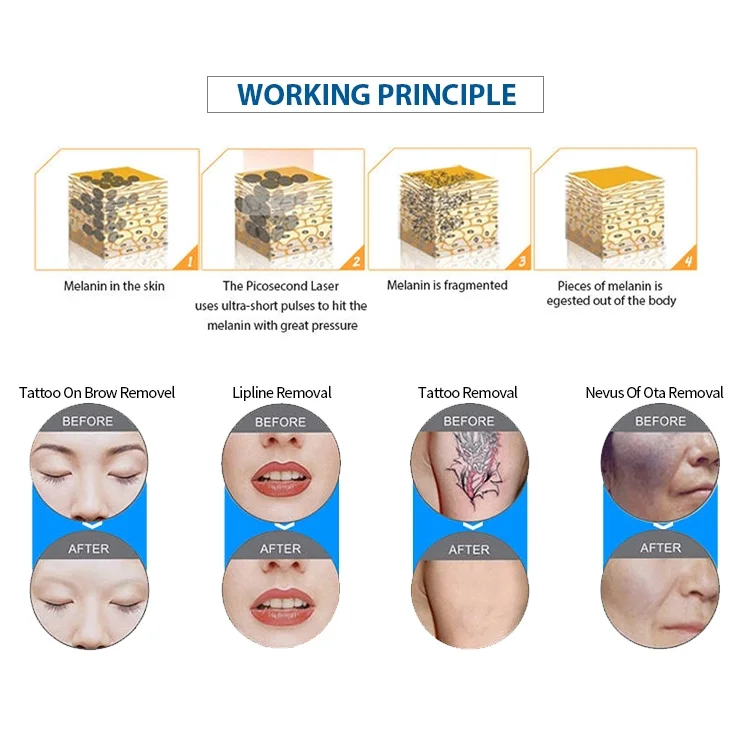
Tattoo particles have a short thermal relaxation time. Energy must arrive rapidly while limiting heat exposure. Q-switched devices generally work in nanoseconds. True picosecond systems work in trillionths of a second. Both can succeed when wavelength and parameters match the target. Buyers should request pulse-width test documentation.
Wavelength Coverage for Black, Red, Green, and Blue Ink
Wavelength often matters more than the technology label. Black pigment absorbs a broad spectrum and commonly responds to 1064nm Nd:YAG. The 532nm wavelength sees use for red, yellow, orange, and brown pigments. Blue and green inks may require other wavelengths or a carefully selected platform. A clinic that advertises multicolor tattoo removal should build its menu around verified wavelength capability, not a general marketing claim.
Skin-Type Flexibility and Risk Management
Darker skin contains more epidermal melanin. This fact increases the need for careful patient selection and parameter control. The 1064nm wavelength sees common preference for dark pigment and darker skin types. Equipment never replaces training. Medical history, tattoo assessment, skin typing, consent, protective eyewear, and realistic expectations remain essential because pigment changes, burns, blistering, scarring, or incomplete clearance can occur.
Treatment Speed, Spot Size, and Clinic Throughput
Repetition rate influences coverage speed. Spot size affects the treatment area and useful penetration. Larger spots may shorten treatment time only when energy stays stable and uniform. Calculate throughput from the complete workflow, including consultation, preparation, treatment, cooling, and cleaning, rather than from a shots-per-second headline alone.
Total Cost of Ownership: Purchase Price Is Only One Factor
Maintenance, Lamp Life, Cooling Systems, and Downtime
A low quotation can become expensive when cooling, maintenance, or parts support remains weak. Calculate ownership cost using:
1. Purchase, shipping, installation, and training
2. Lamps, filters, water, and service parts
3. Preventive maintenance and downtime
4. Expected treatment volume and price per session
Also ask whether routine maintenance and troubleshooting can receive remote handling.
Training, Warranty, Spare Parts, and Technical Support
KES laser supports buyers with R&D and after-sales resources, training materials, online assistance, and multilingual communication. Our process includes incoming-material inspection, ERP-based storage management, energy-output and stability testing, packaging, and delivery controls. Clinics should confirm warranty scope, parts availability, training, response procedures, and local responsibilities in writing.
A Clinic Buyer’s Decision Matrix for 2026
Best Choice for New and Budget-Conscious Clinics
Start with the treatments most likely to generate bookings. If most anticipated cases involve black, dark blue, red, or brown ink, a 1064nm and 532nm Q-switched Nd:YAG platform may provide a sensible foundation. Prioritize stable energy, simple operation, service access, and room to expand the treatment menu.
Best Choice for High-Volume and Multicolor Tattoo Clinics
A high-volume clinic should compare sustained repetition rate, spot size, thermal management, beam uniformity, and ergonomics. A premium system may receive justification when resistant or multicolored cases support the investment.
Illustrative case: a new clinic treating mostly black tattoos may choose a serviceable Q-switched system and reserve budget for training. A practice receiving complex-color referrals may value verified advanced pulse performance and broader wavelengths.
Questions to Ask a Tattoo Removal Laser Manufacturer Before Requesting a Quote
Ask these six questions:
1. What are the verified pulse width, energy, frequency, and spot-size ranges?
2. Which wavelengths and tips are included?
3. What cooling system supports continuous operation?
4. Which certificates apply to the exact configuration and market?
5. What training, warranty, parts, and response times are provided?
6. Can the supplier support OEM or ODM requirements?
KES laser has manufactured light-based medical and aesthetic systems since 1999 and supports OEM and ODM work involving industrial design, mechanical design, software, interfaces, functions, and branding.
How KES Laser Tattoo Removal Systems Fit Different Clinic Needs
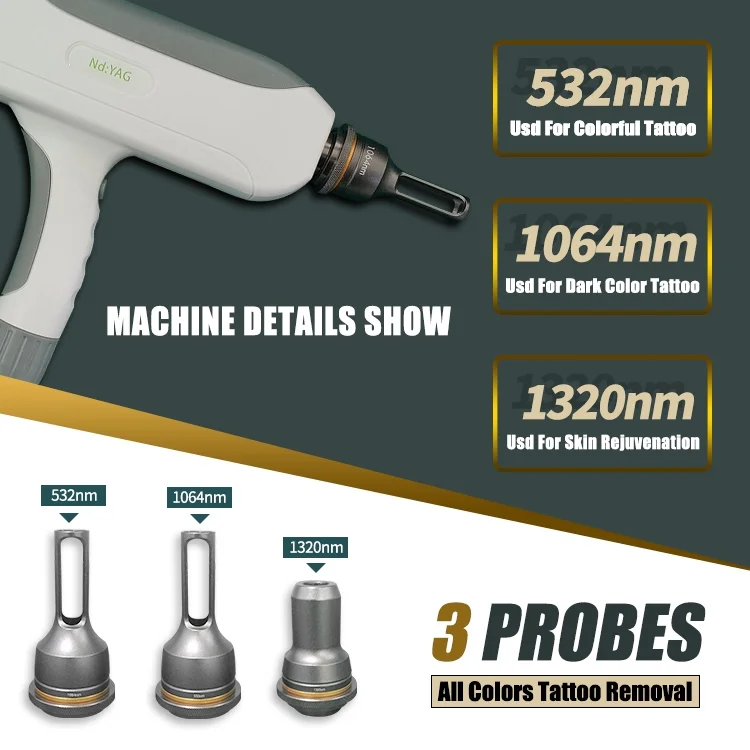
For clinics seeking a practical Q-switched platform, the KES laser AL1 provides standard 1064nm, 532nm, and 1320nm tips, adjustable 1–10Hz frequency, a 1–8mm spot range, an aiming beam, an 8.4-inch touch screen, and air, water, and radiator cooling. The modular internal design aims to simplify maintenance and after-sales work.
The MED-810A configuration adds a double-rod design, adjustable energy, an 8.4-inch interface, and air, water, and twin-radiator cooling. The MED-860 RENO configuration includes 1064nm and 532nm wavelengths, 1–10Hz operation, a 2–10mm adjustable spot, red aiming light, water cooling, and a Top-Hat beam concept intended to distribute energy more uniformly.
The correct choice depends on verified specifications, expected tattoo colors, clinic volume, staff experience, and regional compliance. We recommend confirming the final configuration and supporting documents before purchase.
FAQ
Q: What is the best laser for tattoo removal in 2026?
A: The best system matches the clinic’s patient skin types, common ink colors, treatment volume, budget, and support needs. Picosecond technology may suit advanced or resistant cases. A multi-wavelength Q-switched Nd:YAG platform remains a strong option for many clinics.
Q: Which tattoo removal laser is better for darker skin tones?
Clinics frequently choose the 1064nm Nd:YAG wavelength. Reduced uptake by epidermal melanin accounts for this selection versus lower wavelengths. The procedure requires careful parameters. Staff must evaluate the patient next. Appropriate cooling aids the treatment. Staff perform test spots if necessary. Only qualified operators handle the procedure.
Q: How much does a professional tattoo removal laser machine cost?
A: Pricing differs by pulse technology, wavelengths, energy performance, optical design, cooling, accessories, certification, training, warranty, and service. Clinics should compare total ownership cost and expected utilization.