

Choosing laser tattoo removal equipment goes beyond simply picking the highest energy number or the latest technology brand. A medical facility must match the system to patient mix, treatment volume, staff capability, regulations, and financial plan.
The best tattoo removal machine delivers steady and suitable energy for the treatments the facility actually performs. This approach moves from clinical needs to technical evaluation, supplier review, and return-on-investment planning.
Start with Your Facility’s Treatment Profile
What Types of Tattoos, Ink Colors, and Skin Types Will You Treat?
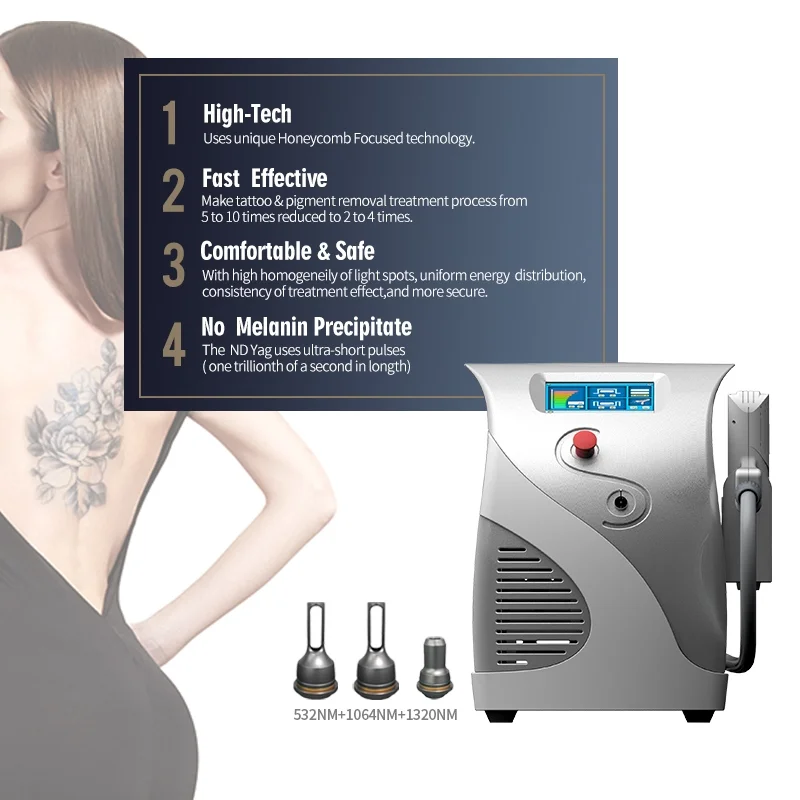
Start with real patient demand. Record the proportion of professional, amateur, cosmetic, black, and multicolored tattoos in the local market. Dark ink is commonly addressed with 1064 nm, while 532 nm is used for colors such as red, brown, and coffee tones. Skin type, pigment depth, previous treatments, and tattoo density also influence parameter selection.
Choose wavelength coverage that supports frequent cases and allows sensible service expansion, rather than buying options only because they look impressive.
How Many Treatments Will Your Facility Perform?
A startup clinic has different requirements from a hospital department or chain clinic running appointments all day. Estimate treatments per day and month. Also estimate average tattoo size. Consider time between patients. Check peak-hour workload. Finally, review treatment-room space.
For higher volumes, examine repetition rate, cooling, energy stability, maintenance access, and operating capacity. A compact unit may suit a limited room. A busy facility may prioritize heat management.
What Clinical and Business Goals Should the Equipment Support?
Decide whether the system will be used only for tattoo removal or also for selected pigmentation services. Additional tips may expand the treatment menu, but the tips should not distract from the main purchase goal.
Separate requirements into essential functions, useful options, and unnecessary extras. This separation helps avoid paying for features the team cannot use or local rules do not permit.
Compare Laser Technologies and the Specifications That Matter
Q-Switched Nd:YAG or Picosecond: Which Technology Fits Your Facility?
Both technologies can suit professional practice. Q-switched Nd:YAG systems are widely used for tattoo and pigment applications and may offer an accessible investment route. Picosecond platforms use shorter pulses and are often positioned for premium services.
| Decision factor | Q-switched Nd:YAG | Picosecond platform |
|---|---|---|
| Purchase profile | Core service or cost-controlled expansion | Premium positioning |
| Evaluation priority | Stable output and wavelength fit | Verified pulse performance and usable energy |
| Staff needs | Protocol training and parameter control | Advanced training and case selection |
| Best choice when | It suits routine cases and volume | Demand supports the investment |
Technology name alone does not identify the best laser for tattoo removal. Request complete specifications, output verification, training, and service terms.
How Should Wavelength, Pulse Duration, and Spot Size Be Evaluated Together?
Wavelength determines the pigment range a system is intended to target. Pulse duration, energy, and spot size determine how that energy is delivered. A large maximum-energy figure has limited value if the figure cannot be maintained at practical spot sizes or frequencies.
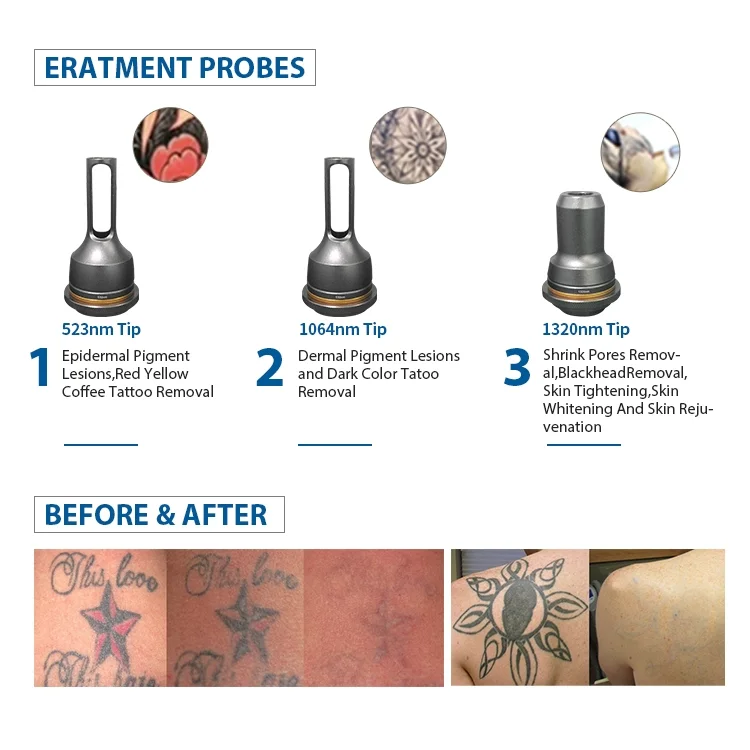
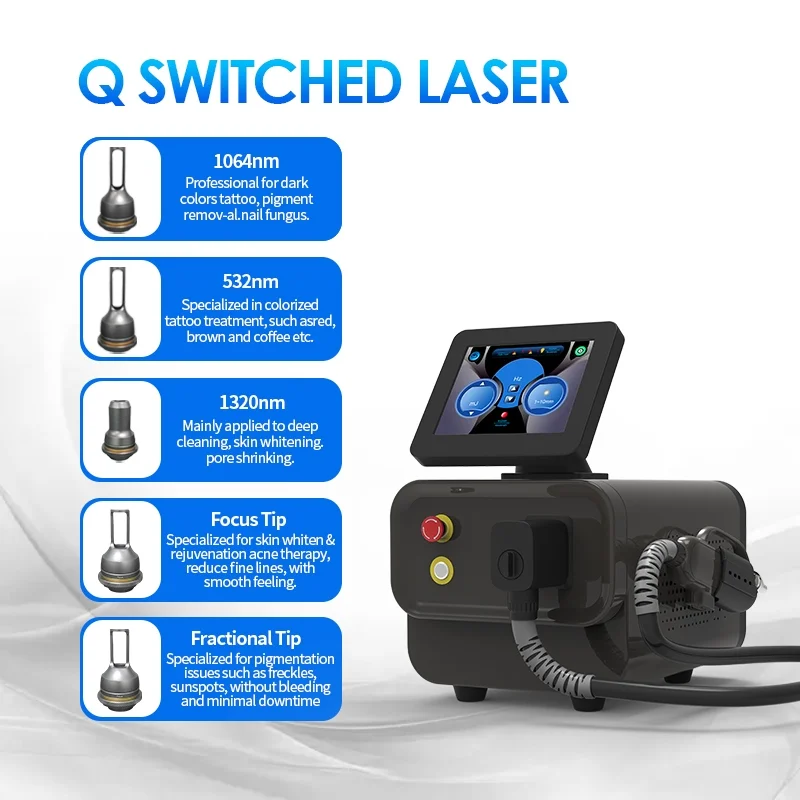
At KES laser, documented Q-switched configurations include 1064 nm and 532 nm options for dark and selected colored tattoos. Certain configurations also include 1320 nm and additional treatment tips. Available specifications across these systems include adjustable 1–8 mm spot sizes, 1–10 Hz operation, nanosecond pulse delivery, aiming beams, and air, water, and radiator cooling. Buyers should always confirm the selected configuration.
Why Do Beam Quality, Energy Stability, Repetition Rate, and Cooling Matter?
Beam quality affects how evenly energy reaches the treatment area. A homogeneous profile supports controlled delivery and helps avoid hot spots. Operators also need repeatable output over a full session, not only a strong first pulse.
Repetition rate influences working pace, but faster is not automatically better. Cooling and stable output must support repetition rate. During a demonstration, run the unit at realistic settings and observe temperature behavior, alarms, beam consistency, and interface response.
Check Safety, Compliance, and Daily Usability
Which Safety and Regulatory Documents Should Buyers Verify?
Request documents for the exact model and configuration. Check the issuing body, product name, certificate scope, validity, electrical safety information, laser reports, labeling, and local registration requirements.
- Device and manufacturer identification
- Applicable CE, Medical CE, FDA, or local documents
- Electrical and laser safety reports
- Quality-management documentation
- Calibration or inspection records
- Required protective accessories
Approval in one market does not automatically authorize use in another. The facility must confirm local rules.
What Training, Maintenance, and Technical Support Are Included?
Ask who trains operators, what topics are covered, whether refresher training is available, and how protocol questions are handled. Maintenance terms should identify routine checks, cooling-system care, calibration, parts, warranty exclusions, and response procedures.
Training should include operating procedures, parameter selection, safety routines, basic troubleshooting, and post-treatment guidance. Support should be available in formats the team can use, such as manuals, videos, remote sessions, and direct technical communication.
Calculate Total Cost of Ownership and Expected ROI
What Costs Exist Beyond the Initial Purchase Price?
The purchase price is only one budget line. Include shipping, import charges, installation, training, protective equipment, maintenance, replacement parts, cooling-system service, room preparation, marketing, financing, and downtime.
Compare quotations with a three-year or five-year ownership model. A cheaper machine may cost more when parts are scarce, or support is slow.
How Can a Clinic Estimate Treatment Capacity and Break-Even Time?
Use a conservative calculation. Monthly contribution equals completed treatments times average treatment fee minus monthly operating costs. Break-even period equals total initial investment divided by monthly contribution.
Procurement scenario: A clinic expects 45 treatments per month but budgets at 30 to allow for cancellations and a gradual launch. The clinic subtracts staffing, maintenance allowance, marketing, financing, and expected downtime from projected revenue. If this conservative case remains sustainable, the purchase is more defensible than one based on full capacity.
Also test expected and growth scenarios, including utilization 20% below plan.
Use a Vendor Evaluation Checklist Before Making the Final Decision
How Should Medical Facilities Compare Tattoo Removal Equipment Suppliers?
Use the same scorecard for every supplier.
- Confirm wavelengths and treatment-tip configuration.
- Compare usable energy, pulse duration, frequency, and spot size.
- Request evidence of stable output and beam distribution.
- Review cooling, maintenance access, and workload capacity.
- Verify model-specific regulatory documents.
- Examine training, warranty, parts, and response times.
- Check manufacturing experience and quality controls.
- Request a live demonstration or operating test.
KES laser has developed light-based medical and aesthetic equipment since 1999. KES laser supports OEM and ODM work covering industrial, mechanical, software, functional, interface, and logo design. The documented tattoo and pigmentation range includes portable and higher-output Q-switched configurations, modular structures, multilingual interfaces, adjustable parameters, and different tip combinations. We also provide manuals, video resources, online training, multilingual communication, and after-sales troubleshooting.
The right purchase is the system whose treatment coverage, capacity, documentation, support, and ownership cost fit the facility’s real plan.
FAQ
Q: What factors should be considered when purchasing a tattoo removal machine for a clinic?
A: Consider patient skin types, common ink colors, treatment volume, wavelength coverage, pulse delivery, usable energy, spot size, beam quality, cooling, compliance documents, training, maintenance, supplier response, and total ownership cost.
Q: What is the best laser for tattoo removal in a medical facility?
A: The best laser matches the facility’s cases, staffing, workload, regulatory market, and budget. A highly specified system is not the right choice when most of its capabilities will rarely be used.
Q: Is a picosecond laser always better than a Q-switched tattoo removal machine?
A: No. Picosecond systems may support premium positioning, while Q-switched Nd:YAG equipment can provide practical wavelength coverage and a different investment profile. Compare verified output, training, support, and financial fit.
Q: Which wavelengths should the best laser tattoo removal machine include?
A: Many professional devices for tattoo removal use 1064 nm for dark pigments and 532 nm for selected colored inks. Additional wavelengths or tips should reflect the clinic’s target cases and the verified device configuration.
Q: How much does professional laser tattoo removal equipment cost to operate?
A: Operating cost includes maintenance, parts, calibration, cooling-system care, staff time, financing, and revenue lost during downtime. Build a multi-year cost model before comparing quotations.